


Priced at only two-thirds of imported machines, the Phan Tan straw baler produces tighter and more visually appealing bales than Japanese machines.
In recent years, farmers across the Mekong Delta provinces have gained a new source of joy from “made in Vietnam” straw balers. After combine harvesters pass through, leaving long golden rows of straw across the fields, straw baling vehicles follow behind, gently rolling up massive straw bales in a neat and orderly manner. The entire baling vehicle—including the rear platform that holds the finished bales—occupies an area no larger than a small room of about 9 m². Another notable feature is that the machine requires only two operators: one to drive the vehicle and one to stack the straw. In this way, the machines travel across the fields and deliver thousands of dry straw bales to collection points.
This special vehicle was designed and assembled by engineer Phan Tan Ben, Director of Phan Tan Company. Officially upgraded to company status in 2014, Phan Tan initially maintained a family-scale management structure with only about five people. However, the company now operates four production workshops with more than 70 technicians and workers. With over 30 years of experience in the field, Mr. Ben has developed more than 15 inventions and has brought thousands of products based on these inventions to the market. The straw baler is one of his proud innovations, inspired by the idea of “turning straw into money” after recognizing the region’s abundant straw resources and the demand for straw for cattle feed, mushroom cultivation, mulching dragon fruit roots, producing bio-fertilizer, and more—rather than having farmers burn straw after harvests.
The vehicle was researched over many years, drawing on the platform of combine harvesters. It uses rubber tracks, allowing it to operate in muddy conditions and across various terrains, overcoming several shortcomings of other products on the market, such as operation limited to dry fields, large dimensions, and heavy weight. Each day, two operators can bale straw over more than 4 hectares of fields. The baling unit is positioned at the front, enabling easier operation and allowing the operator to adjust bale size as desired. Each bale weighs approximately 12–15 kg on average, and the rear platform can carry up to 30 bales.
“Currently, the selling price of this vehicle is 286 million VND per unit. With materials that we design and manufacture ourselves, along with the engine system and some other components that must be purchased, it takes us only two days to complete one new vehicle. Recently, we received an order from Binh Minh Cooperative (Tien Giang) for 15 straw balers. To date, Phan Tan has sold approximately 120 units,” Mr. Ben shared.
 |
Mr. Si Pha, a straw trader, said that demand for straw baling vehicles is quite high. “I buy a machine to provide baling services for people who want to store straw, or I store straw myself and wait for better prices. On average, I transport and sell about 1,000 straw bales per day at prices ranging from 2,000 to 4,000 VND per kilogram. Each day, I harvest around 800 bales, with each bale weighing about 14–15 kg. Those with more capital can purchase two or three machines and earn higher income.”
In addition to straw balers, Phan Tan has also introduced to the market a “3-in-1” harvester capable of harvesting rice, corn, and mung beans. This machine functions like a combine harvester and has already been sold in several locations, with nearly 20 units delivered. Phan Tan has also sold more than 700 agricultural transport vehicles. Due to differences in production stages and continuous improvements over time, prices may vary. Currently, the selling price of the agricultural transport vehicle is approximately 100–110 million VND, while the “3-in-1” harvester is priced at 360 million VND.
According to a survey by NCDT, compared with the prices of imported machines with similar functions, Phan Tan’s machines are priced at only about two-thirds of imported products. For example, straw balers imported from Japan are currently priced at over 400 million VND per unit, yet their operating capacity is only about one-third of that of Vietnamese machines. Mr. Si Pha also observed that Vietnamese-made machines can produce tighter and more visually appealing straw bales than Japanese machines. In addition, imported combine harvesters are quite selective about terrain and therefore face disadvantages during the rainy season due to their tendency to sink into muddy fields. Meanwhile, Vietnamese machines are designed based on local operating conditions, which helps minimize these difficulties.
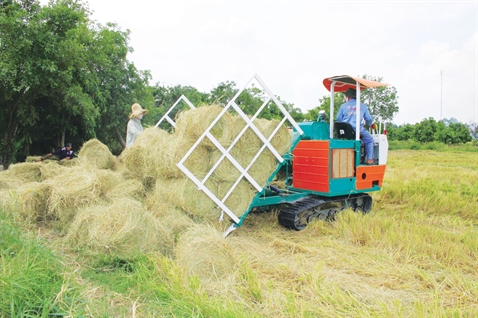 |
| Compared with the prices of some imported machines with similar functions, Phan Tan’s machines are priced at only about two-thirds. Photo: youtube.com |
Alongside these advantages, a representative of Phan Tan Company also shared the challenges of market integration. Currently, Phan Tan’s machines have been exported to only two countries—Myanmar and Tanzania—with a total of 12 units. The main reason is that the company has not yet been able to fully implement after-sales policies, including warranty, maintenance, and the supply of spare parts and repair services. As a result, Phan Tan primarily focuses on the domestic market.
However, even in the domestic market, the company still faces difficulties because consumers have not yet fully trusted Vietnamese-made machinery brands, despite their higher productivity and lower prices. Therefore, in addition to support and favorable policies from the Government for agricultural machinery manufacturers, the company also needs greater trust from consumers. Only then can Vietnamese agricultural machinery brands be strong enough to compete with foreign brands.
Duc Tai